martedì 11 agosto 2026

ApollonIA

Un po' per gioco, un po' per testare le potenzialità dei sistemi generativi in ambito artistico ho creato una band AI di rap napoletano che possa "raccontare" di temi di interesse sociale e culturale del mio paese (Casapulla, da "Casa di Apollo") e dintorni. 

Da qui il nome ApollonIA

Tutto ciò che sarà generato - che richiederà editing e prompting iterativo - sarà distribuito in modo completamente gratuito e in modalità copyleft (Creative Commons ShareAlike / CC BY-SA). Questo progetto socio-tecnico non ha alcuno scopo di lucro ed è portato avanti con l'idea e la speranza - da semplice cittadino - che il linguaggio artistico possa essere uno strumento per veicolare messaggi di interesse sociale.

I nomi d'arte dei "fondatori" e "artisti" di questa band digitale (naturalmente tutti fittizi) sono:

- Mick Republic

- PietrOne (aka Pietr1)

- Jack Open Mind

Dato che è un progetto avrà una durata limitata: la "band" cesserà di esistere quando saranno generate 10 canzoni (idealmente un numero di tracce tipico per un album).

Come si dice in questi casi: "Stay tuned!"

Userò questo canale di distribuzione https://www.spreaker.com/user/apollonia--19250977  con contenuti disponibili anche su Spotify.

giovedì 9 aprile 2026

Note sparse su "Inganni e Potere: il gaslighting" (Edizione Spartaco, 2024) e Tecnologie Persuasive

Si legge con piacere "Inganni e Potere: il gaslighting" (Edizione Spartaco, 2024), scritto da Rita Raucci, Stefania Sparaco, Maria Giovanna Petrillo e Claudio Lombardi. Il libro si compone di quattro saggi che inquadrano in modo diverso, ma complementare, il tema della manipolazione psicologica che va sotto il nome di "gaslighting". Partendo dall'analisi degli aspetti giuridici e da quelli riguardanti i rapporti di genere del fenomeno, gli autori arrivano poi a discuterne le sue fattispecie tecnologiche e sociali, attraversando cinema e letteratura. 

Il gaslighting, ho scoperto, è un tipo particolare di manipolazione in cui il manipolatore, in virtù di un rapporto di potere asimmetrico instaurato con la vittima (che può essere causato da aspetti affettivi, di status, genere etc), riesce a far credere a quest'ultima di essere (o non essere) qualcosa (es. può farle/fargli credere di "essere pazza/o", come accade alla Paula del film "Gaslight" di Cukor, o, ad esempio, di "non essere abbastanza <in gamba/adatt*/all'altezza della situazione> etc...",  come invece può, più prosaicamente, accadere nella vita di tutti i giorni a ciascun* di noi). 

In altri termini: il gaslighting è una forma di manipolazione che mira a far dubitare la vittima (e chi le sta intorno, quando si passa dal circuito interpersonale a quello sociale) di sé stessa tramite l'utilizzo e la diffusione di informazioni false e inganni di diverso tipo.

Il libro è di particolare interesse perché il tema della manipolazione si intreccia con quello della persuasione: argomento principe della dialettica e della retorica.

Questo intreccio è particolarmente importante quando si passa dalla dimensione interpersonale a quella sociale dove, in special modo nel contesto attuale, la tecnologia - e, nello specifico, chi governa questa forma di (sesto?) potere - assume un ruolo di rilievo.

Il tema della progettazione di tecnologie persuasive (in cui i tentativi di "persuasione automatizzata" sono rivolti al miglioramento della vita delle persone: ad es. ad assumere delle consuetudini comportamentali più sane quali non fumare, vaccinarsi, alimentarsi correttamente etc.) rappresenta un ambito di ricerca di grande interesse scientifico.

In tale contesto di studi, un dato che emerge in modo significativo è che non è così facile persuadere le persone a credere o (ancora più difficile) a fare qualcosa che non siano già disposte a credere/fare.

Questa limitazione è riconosciuta anche in studi recenti che evidenziano, invece, le potenzialità persuasive dei sistemi di IA generativa. 

Ad esempio: un recente lavoro pubblicato su Nature Human Behavior mostra come, nel contesto dei cosiddetti micro-dibattiti (conversazioni dialogiche dalla durata limitata), l'IA abbia un effetto persuasivo su utenti umani ma solo quando, accedendo a informazioni personali relative ai suoi interlocutori, personalizza le proprie risposte (quando non lo fa, non ci sono differenze tra dibattiti svolti con IA rispetto a quelli esperiti con umani). Sul tema della personalizzazione dei contenuti (e degli effetti persuasivi dell'IA) un risultato diverso (addirittura opposto) invece emerge da questa ricerca su Science (su 77.000 utenti) che, pur collocandosi nell'alveo degli studi che mostra una efficacia persuasiva dei sistemi di AI generativa, evidenzia anche come ciò non avvenga affatto quando l'interazione è personalizzata bensì quando l'AI opera nel framework della cosiddetta "Rational persuasion" (che si differenzia e contrappone rispetto a modalità di utilizzo di tecniche "manipolatorie"). Vale a dire: i modelli risultano essere persuasivi quando forniscono maggiormente affermazioni suscettibili di fact-checking (ossia potenzialmente "controllabili": sarebbe l'illusione di tale controllo ad orientare gli utenti a fidarsi delle affermazioni ricevute). Su questa linea, un ulteriore recentissimo lavoro dai laboratori Google su un campione di circa 10000 persone,  dimostra ancora come l'utilizzo del potenziale manipolatorio di tali sistemi - messo in azione laddove esplicitamente richiesto dai ricercatori - non correli con l'efficacia manipolatoria degli stessi (il cambiamento di opinione si verifica in certi casi ma non in altri e non si sa bene perché).  Anche i lavori dell'ultimo decennio del gruppo di Quattrociocchi, hanno mostrato - con studi condotti su larga scala e su tutte le principali piattaforme social -  come le persone non siano marionette guidate da algoritmi onnipotenti. Ma cercano attivamente le informazioni che confermano le proprie convinzioni (confirmation bias). Le piattaforme, di fatto, sembrano amplificare queste dinamiche umane, ma non le creano.

In modo simile, alcuni risultati della mia stessa attività di ricerca sul connubio tra tecnologia e persuasione confermano questo trend di risultati in divenire e ancora fortemente contradditori. Ad esempio, i saggi "Influencing the Others’ Minds" (2014), When Personalization Is Not an Option" (2019) e "A Storytelling Robot" (2023) e "Gamified Platform (2024) mostrano l'efficacia parziale di alcune tecniche persuasive - come, ad esempio, l'appello all'autorità - quando applicate nell'ambito dell'interazione umano-macchina (nei contesti di siti di e-commerce, di piattaforme mobile, testate giornalistiche online, serious games e robot simulati) e, di converso, la completa inefficacia di altre strategie, ad es. l'appello alla maggioranza, ritenute altresì efficaci sin dai tempi della Retorica aristotelica. Da ultimo, questo lavoro effettuato con robot fisici e pubblicato su IEEE Affective Computing mostra, in controtendenza rispetto a quanto ci si potesse aspettare e ad altri studi analoghi sugli effetti persuasivi dei discorsi empatici tra persone (human-human interaction), che avere un robot in grado di ingaggiare un dialogo in consonanza emotiva ed empatica con un interlocutore umano, non ne aumenta l'efficacia persuasiva. 

Su una sottile linea rossa che collega cautela e scetticismo si colloca anche un nuova pubblicazione su Science che mostra come i sistemi di AI "adulatori" (Sycophantic AI), vale a dire quelli che tendono a confermare sempre le opinioni dell'utente anche quando andrebbero corrette, riscuotono una maggiore fiducia e vengono percepiti come qualitativamente migliori dagli utenti umani; rafforzando, di fatto, negli stessi utenti, le proprie idee precostituite su un determinato argomento e creando, di fatto, delle nuove echo-chambers (persuasivamente inespugnabili) fatte non più da gruppi digitali di utenti ma da coppie umani-sistemi di IA. In questo scenario, il successo di un qualsiasi tentativo manipolatorio (incluso quello di gaslighting) che sia contrario al sistema di credenze originali dell'individuo (o degli individui) target sembra un risultato con una possibilità molto bassa di successo.

Insomma: dalla letteratura sul tema delle tecnologie persuasive emerge un quadro senza una teoria chiara, ricco di risultati frastagliati e di non facile interpretazione. Ciò rende questo filone di ricerca un terreno fecondo di esplorazione a analisi scientifica. All'interno di questo cosmo di conoscenza in formazione e divenire costante, tuttavia, emerge in modo sistematico un aspetto, poco raccontato nella narrativa mediatica sul tema: anche quando l'evidenza empirica evidenzia reali effetti persuasivi operati tramite sistemi tecnologici, vengono tracciati confini e perimetri abbastanza netti che si conciliano poco con la narrazione mainstream della "dittatura degli algoritmi" (o di chi li governa). Questo è un aspetto da tenere in considerazione quando si parla di manipolazione sociale: un fenomeno che sembra ancora pervicacemente legato a dinamiche e tendenze cognitive tutte umane (troppo umane?). Almeno per ora...

Da questo punto di vista, il libro fornisce una prospettiva equilibrata: evitando di scendere in narrazioni apocalittiche, propone una disamina ragionata dei possibili rischi cui alcuni tipi di deriva tecnologica possono portare ed è una chiamata all'azione che chiede di fare luce su un fenomeno complesso.


Riferimenti

Akbulut, Canfer, Rasmi Elasmar, Abhishek Roy, Anthony Payne, Priyanka Suresh, Lujain Ibrahim, Seliem El-Sayed et al. "Evaluating Language Models for Harmful Manipulation." arXiv preprint arXiv:2603.25326 (2026).

Augello, A., Città, G., Gentile, M., & Lieto, A. (2023). A storytelling robot managing persuasive and ethical stances via act-r: an exploratory study. International Journal of Social Robotics, 15(12), 2115-2131.

Buracchio, Giorgia, Ariele Callegari, Massimo Donini, Cristina Gena, Antonio Lieto, Alberto Lillo, Claudio Mattutino et al. "Emotion Alignment in Human-Robot Interaction: Effects on Communication Styles and Persuasion."IEEE Transactions on Affective Computing. 

Capecchi, S., Lieto, A., Patti, F., Pensa, R. G., Rapp, A., Vernero, F., & Zingaro, S. (2024). A gamified platform to support educational activities about fake news in social media. IEEE Transactions on Learning Technologies, 17, 1765-1779. (2025),  

Cheng, M., Lee, C., Khadpe, P., Yu, S., Han, D., & Jurafsky, D. (2026). Sycophantic AI decreases prosocial intentions and promotes dependence. Science, 391(6792), eaec8352.

Cinelli, M., De Francisci Morales, G., Galeazzi, A., Quattrociocchi, W., & Starnini, M. (2021). The echo chamber effect on social media. Proceedings of the national academy of sciences, 118(9), e2023301118.

Gena, C., Grillo, P., Lieto, A., Mattutino, C., & Vernero, F. (2019). When personalization is not an option: An in-the-wild study on persuasive news recommendation. Information, 10(10), 300.

Hackenburg, Kobi, Ben M. Tappin, Luke Hewitt, Ed Saunders, Sid Black, Hause Lin, Catherine Fist, Helen Margetts, David G. Rand, and Christopher Summerfield. (2025) "The levers of political persuasion with conversational artificial intelligence." Science 390, no. 6777 : eaea3884.

Lieto, A., & Vernero, F. (2014). Influencing the Others’ Minds: An Experimental Evaluation of the Use and Efficacy of Fallacious-Reducible Arguments in Web and Mobile Technologies. PsychNology Journal, 12(3), 87-105.

Salvi, F., Horta Ribeiro, M., Gallotti, R., & West, R. (2025). On the conversational persuasiveness of GPT-4. Nature Human Behaviour, 9(8), 1645-1653.

Zollo, F., Bessi, A., Del Vicario, M., Scala, A., Caldarelli, G., Shekhtman, L., ... & Quattrociocchi, W. (2017). Debunking in a world of tribes. PloS one, 12(7), e0181821.

domenica 2 novembre 2025

Morte di un cibernetico napoletano

Sono stato alla commemorazione in onore di Giuseppe Trautteur (condivido qui un suo ricordo di Guglielmo Tamburrini) tenutasi a Napoli presso l'Istituto Italiano per gli Studi Filosofici, a Palazzo Serra di Cassano.

Giuseppe Trautteur è stato - in Italia - un pioniere e un riferimento (per generazioni di studiosi) della cibernetica (poi scienze cognitive) e dell'intelligenza artificiale. Conosciuto grazie a Roberto Cordeschi e Marcello Frixione durante i loro anni salernitani, l'ho poi incontrato successivamente in diverse occasioni.

Tra i ricordi più belli e recenti che conservo con lui c'è un panel del 2017 (da cui è tratta la foto in basso) che organizzai a Bari come evento della conferenza AI*IA 2017, coordinata da Floriana Esposito e dal gruppo barese di AI. Quel panel (intitolato: Can AI and Cognitive Science still live together happily ever after) è stato il primo evento congiunto tra Associazione Italiana per l'Intelligenza Artificiale e Associazione Italiana di Scienze Cognitive e vide come partecipanti: Amedeo Cesta, Antonio Chella, Fabio Paglieri, Oliviero Stock e Giuseppe Trautteur.


Ho visto Giuseppe un'ultima volta lo scorso febbraio, quando venne a moderare (un po' a sorpresa), a Napoli, una sessione di questo evento in cui presentavo un mio lavoro https://sites.unimi.it/brio/brio-meeting-unina-unit/
. Di quest'ultima volta ricordo, come sempre, le sue osservazioni brillanti. 

La sua perdita è incolmabile: una persona con un sapere così ampio (e al contempo profondo) è impossibile da ritrovare, specialmente nella ipersettorializzazione (spesso miope) dell'accademia italiana di oggi. La scorsa settimana, nell'ambito della decima edizione del workshop internazionale su Artificial Intelligence and Cognition (AIC 2025) tenutosi nell'ambito della conferenza ECAI a Bologna (foto in basso), non ho potuto fare a meno di dedicare l'evento alla sua memoria (un piccolo attestato di riconoscenza, in attesa di eventi ben più importanti che andranno organizzati per ricordare il suo lascito intellettuale e scientifico).


Ieri è stato molto bello ascoltare i numerosi ricordi delle tante persone che hanno avuto la fortuna di collaborare - in vario modo - con lui. 

La sensazione di fondo che ho percepito è stata, però, da parte di tutti i presenti e di coloro che sono intervenuti, la difficoltà a trovare le parole giuste: quelle in grado descrivere in modo adeguato la grandezza dello scienziato e dell'uomo. Tutte e tutti erano consci del fatto che la verbalizzazione del ricordo - seppure lucida, chiara, sincera, affettuosa - non restituiva la pienezza dell'esperienza vissuta.


Mi è venuto in mente l'epilogo del celebre film di Martone "Morte di un matematico napoletano", dedicato alla vita di Renato Caccioppoli, in cui è evidente - durante il commiato finale dal grande matematico - la costernazione per l'inadeguatezza del linguaggio nell'afferrare pezzi di vita irripetibili. Con Giuseppe Trautteur, se ne va l'ultimo grande l'ultimo grande cibernetico della scuola napoletana fondata da Edoardo Caianiello.


martedì 8 aprile 2025

Feedback by Péter Érdi

The notion of feedback represents one of the most important contribution of the cybernetics to the science of (any) complex systems design. In the cybernetic tradition, machines capable of adapting themselves actively to the environments via trial-and-error process based on negative feedback (used for autocorrection) were called “servomechanisms” or “negative feedback automata”. A recent example of machines using these type of mechanisms comes from the Artificial Intelligence, since current artificial neural networks (at least the once that are more successful nowadays) make use, in their supervised learning phase, of a well knoan feedback mechanism called "backpropagation". 


The book "Feedback, how to destroy or save the worlds" (Springer, 2024) by Péter Érdi is an intellectual journey in the science of feedback and shows, with clear examples coming from different fields, how either the design or the discovery of feedback mechanisms is crucial for the advancement of science, technology, economics and society since feedback is a crucial component of any complex system.

The book focuses not only on the well known importance of negative feedback (e.g. for learning) but also, and more importantly, on the importance of understanding what are feedback mechanisms governing the behavior of a certain system and upon which it is possibile to intervene (using both positive and negative corrective signals) in order to lead to (biological/computational/mechanical/physical/chemical...) states that can lead to homeostatsis, market stability, environmental sustainability and so on.

If there is any chance of saving this World, the realization of powerful feedback mechanisms able to avoid catastrophic outcomes represents one of the few elements to put in place. And, in this state of affairs, the science of feedback (Cybernetics) strikes back and seems to be even more relevant today!

sabato 1 febbraio 2025

Why Hinton is Wrong about AI taking over (and about conscious AI)

Recently the The Nobel Prize and ACM, Association for Computing Machinery Turing Award Winner Geoffrey Hinton relaunched his ideas and fears about "AI's taking over" (see this recent interview https://www.youtube.com/watch?v=vxkBE23zDmQ, when he claims that "AI is already conscious" because - among the other things - 1) it has its own goals, 1) it can create subgoals and, 3) since - if implanted in a biological tissue of biological entity that biological entity remains conscious such biological entity remains conscious, as a consequence also the implanted device is (yes he said that). First: the fact that AI systems have goals (always provided by the humans) and create subgoals to achieve them is not new (see e.g. the subgoaling procedure in the cognitive architecture SOAR that relies on the means-end analysis heuristics, used already in the General Problem Solver developed by Newell, Shaw and Simon in 1959! I repeat: 1959!). So these two points do not make any sense. Also the fact that AI systems are able to invent new knowledge (going beyond subgoaling procedures) to solve new problems is not something new: in 2018-2019 with my colleague Gian Luca Pozzato and our students we developed a system that used the TCL logical framework, https://www.antoniolieto.net/tcl_logic.html, to invent new knowledge for solving problems via concept combination, blending and fusion (the paper is here: https://doi.org/10.1016/j.cogsys.2019.08.005 ). None of these things make an AI system conscious: they are just general heuristic procedures that allow a system to have yet another strategy (provided by us) to perform better on unknown tasks. In addition: the discourse that an AI system can functionally replace biological cells/neurons/tissues without making the system subject to this replacement “unconscious” (and therefore - this is how the reasoning of Hinton goes - the AI system is also “conscious”) is a complete nonsense since there is a confusion on many levels. The first confusion concerns the distinction between functional and structural systems (discussed extensively in my book Cognitive Design for Artificial Minds https://www.amazon.com/Cognitive-Design-Artificial-Minds-Antonio/dp/1138207950). The second one - connected to the first - concerns the attribution to a functional component of a “structural” (i.e. cognitive/biological) explanation. This is a sort of ascription fallacy that is also described in the book (and that is very common nowadays). More specifically: of course we can have bionic systems that are integrated - via partial or total replacement - with biological cells and tissues but functional replacement does not imply any biological/cognitive attribution (on this please also see this paper https://doi.org/10.3389/frobt.2022.888199) Think for example to the exoskeletons controlled via semi-invasive medical devices to record brain activity: these systems “function as” our biological counterpart and communicate well with other biological components leading to locomotion. But… Would you say that they (i.e.: the semi-invasive component implanted in our brain in this case…to follow Hinton’s unreasonable reasoning chain) are conscious (just because the biological entity that have them implanted is conscious)? That’s plain wrong and non sense. These kind of claims are completely unjustified and wrong from a scientific perspective and have nothing to do with the typical concerns and legitimate discussions about the risks coming from the societal and ethical impact that AI has any technology.

mercoledì 31 maggio 2023

Large Language Models, Super Human Intelligence and the Methodological Hallucinations of Modern AI

In the last months a major source of confusion related to the interpretation of the behavior exhibited by the current state of the art AI systems (e.g. Large Language Models like GPT4 and chatGPT for natural language processing) is due to the wrong ascription of cognitive capabilities to them. This confusion, when genuine (and not generated ad-hoc like in this case), is factually wrong since it prefigures Strong AI scenarios that are scientifically ungrounded (while there are reasons to urgently consider other ethical issues regarding the impact on the society of these techologies from the point of view of the biases introduced, their potential misuse, their impact on the job market etc.) 
In particular, the expression “Strong AI” was introduced by John Searle to identify the position assuming that computational models, embodied or not, can have a “mind”, a “consciousness” etc. in the same way of human beings. On the other hand, the expression "Weak AI” synthesizes the position according to which computational models can simulate human behaviour and thinking abilities but cannot pretend to possess any kind of “real” cognitive state. 

In Cognitive Design for Artificial Minds (Routledge Books/ Taylor & Francis, 2021) I show how the current #AI and cognitive modelling research are perfectly aligned with the weak-AI hypothesis. In particular, current AI systems, can be described (at the very best) as "shallow”, imprecise and often biologically and cognitively implausible technological depictions of biological brains, from which our intelligent capabilities arise. They are what I call "functionally designed" systems: they apparently "function as" biological brains (i.e. are able to superficially reproduce the same output) but the mechanisms determining that behavior/output are completely different from the ones we know from biology, neuroscience, physiology and cognitive psychology. 

As a consequence, we cannot ascribe theories and faculties explaining biological phenomena to interpret the behavior of such artifacts since the differences and the asymmetries between these classes of systems are enormous (a corollary of this consequence is that also the discourse about the eventual emergence of intentional or "conscious" signals from such systems is literally science fiction). 

 Now: the fact that for "functionally designed" AI systems it is not possible to generate artifacts that can be "intelligent" or "conscious" exactly like us (or like other biological entities) makes it irrelevant also the fear about super intelligent machines. We already have a huge number of systems achieving super-human performances in a number of different tasks (ranging from computer vision to NLP). However their incredible performance is not a symptom of the acquisition of the underlying competence that, in our brains, explains a certain intelligent behavior. 

 And what about the class of “constrained” artificial systems then (i.e. those designed and implemented by explicitly taking into account neuroscientific and/or psychological theories and constraints to build computational models of cognition)? Also for this category of systems, built by adopting what I call in the book a "structural design approach" (Chapter 2), I showed how they can be used to actually simulate the human-like mechanisms determining a given behaviour, and this can enable the understanding of some hidden mechanistic dynamics. Such computational models, therefore, can be used (and are used) to better understand biological or mental phenomena without pretending that that they are the real phenomena that they are modelling. By using a famous analogy proposed by Searle himself: "just as a model of the weather is not the weather, a model of the human mind is not a human mind". 

As a consequence of this state of affairs, both these classes of artificial systems (that are build by following different design principles and with different goals) methodologically fall within the "weak AI" approach.  This consideration - that I argue and detail extensively in Cognitive Design for Artificial Minds - is in contrast with the nowadays popular (but uncorrect) vulgata that see them as instances of the “Strong AI” hypothesis (and that is one of the main sources of confusion on these topics). 

The fact that both the fields of AI and Computational Cognitive Science build models and systems falling within the weak AI hypotheses does not make weaker any of the two disciplines: AI researchers, indeed, continue to build better systems and technologies with the purpose that they can (in principle) be useful for the human beings and that can, in principle, perform better than humans in specific tasks; computational cognitive scientist, on the other hand, continue to build computational simulation of biological/cognitive processes without pretending to build any system able to really be described as “intelligent” or “conscious” in the proper human sense. 

 It is just incredible to see nowadays many comments (including those of AI experts) that are not able to recognize the asymmetries between the incredible technologies that have been built and what biological brains do in the way they are built. It would be about time to dismiss the alarmist claims about the AI and their (hypothetical) existential risks for humanity. They represent nothing less than hallucinations (generated by humans this time) determined by the methodological fog enveloping the modern AI field.

venerdì 26 agosto 2022

Cognitive Design for Artificial Minds on Substack!

Cognitive Design for Artificial Minds (Routledge/Taylor and Francis, 2021) https://www.amazon.com/Cognitive-Design-Artificial-Minds-Antonio-dp-1138207950/dp/1138207950/ has now its Substack channel at https://artificialminds.substack.com! It is possible now to subscribe to the #newsletter to get updates, news and inedited content about the themes and topics of the book. Coming in the next months with podcasts and video interviews!

mercoledì 9 febbraio 2022

Cognitive Design for Artificial Minds nominated in the Top 3 "Best Artificial Intelligence Design Books of All Time" according to BookAuthority

Cognitive Design for Artificial Minds made it to the Best Artificial Intelligence Design Books of All Time. I'm happy to announce that my book, "Cognitive Design for Artificial Minds", made it BookAuthority's Best Artificial Intelligence Design Books of All Time. BookAuthority collects and ranks the best books in the world, and it is a great honor to get this kind of recognition. Thank you for all your support! The book is available for purchase on on Amazon and on the Taylor and Francis website at https://doi.org/10.4324/9781315460536 BookAuthority Best Artificial Intelligence Design Books of All Time

mercoledì 14 luglio 2021

Cognitive Design for Artificial Minds in the list of the "Best New Artificial Intelligence Design Books To Read" according to BookAuthority

Cognitive Design for Artificial Minds made it to the Best New Artificial Intelligence Design BooksBookAuthority Best New Artificial Intelligence Design Books

I'm happy to announce that my book, "Cognitive Design for Artificial Minds", made it to BookAuthority's Best New Artificial Intelligence Design Books:
https://bookauthority.org/books/new-artificial-intelligence-design-books?t=12uofh&s=award&book=1138207926

BookAuthority collects and ranks the best books in the world, and it is a great honor to get this kind of recognition. Thank you for all your support!

The book is available for purchase on Amazon.

giovedì 8 luglio 2021

Cognitive Design for Artificial Minds - Presentation and Discussion (YouTube Videos)

In the past months, the book "Cognitive Design for Artificial Minds" (Routledge/Taylor & Francis, 2021) has been presented and discussed in a couple of events. 

The first event was an invited author presentation at the Northwestern AGI Forum in Seattle on April 28th, 2021 https://www.meetup.com/Northwest-Artificial-General-Intelligence-Meetup-Group/events/277014146/. The presentation was held online and the video is available below


The second one was held on June 30th 2021 and was a joint discussion done on GatherTown with Shiwali Mohan (Xerox Parc, USA), David Peebles (University of Huddersfield, UK), Karen Pollitt-Cham (University of Brighton, UK) and with Antonio Chella (University of Palermo) acting as a moderator. We had a great discussion about some of the main themes touched in the book. The video of the event is also available below and on the YouTube Channel of the book. Enjoy!


venerdì 16 aprile 2021

Cognitive Design for Artificial Minds in the Libraries around the World

The book "Cognitive Design for Artificial Minds" has already found its place in #52 Libraries around the World! 


 This list includes: the Library of Congress, the Libraries of Columbia University in the City of New York, the UCI Langson Library of UC Irvine, the Université de Montréal Library, the McGill University Library, the University of Alberta Library, the Universidad Nacional Autónoma de México Library, the Koninklijke Bibliotheek (KB), nationale bibliotheek van Nederland and many many more.
The data are provided by WorldCat.org (the World's Largest Library Catalog). 

The list full of libraries currently having a copy of the book is available here: https://lnkd.in/dFNMKDj

You can take your copy of Cognitive Design for Artificial Minds on: 

- Amazon.com: https://lnkd.in/dkuhyGK 

venerdì 1 gennaio 2021

Cognitive Design for Artificial Minds on Facebook and Twitter

The book Cognitive Design for Artificial Minds (Taylor & Francis, 2021) has now its own Facebook page and Twitter profile where will be shared updates, events, presentations, excerpts etc. regarding the book. Link to the Facebook page here: https://www.facebook.com/cognitivedesignforartificialminds/ Link to the Twitter account here: https://twitter.com/CognitiveFor

lunedì 14 dicembre 2020

Commonsense reasoning as a key feature for dynamic knowledge invention and computational creativity (Invited Talk)

 I had to oppurtunity to deliver this keynote talk at ICAR-MEET 2020, the annual workshop of the Institute for High Performance Computing of the National Research Council of Italy (CNR).

Below the link to the slides:


Commonsense reasoning as a key feature for dynamic knowledge invention and computational creativity from Antonio Lieto

mercoledì 11 novembre 2020

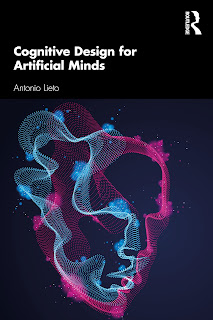
Cognitive Design for Artificial Minds

I am really glad to announce my forthcoming book "Cognitive Design for Artificial Minds" that will be published in 2021 by Taylor & Francis (T&F).

The book can already be pre-ordered in the main online bookshops (e.g. from Routledge (T&F) to Amazon  Walmart  Barnes& Noble etc.)

I am posting below the "blurb" and the Table of Contents of the Book from the Routledge website (T&F).

Cognitive Design for Artificial Minds explains the crucial role that human cognition research plays in the design and realization of artificial intelligence systems, illustrating the steps necessary for the design of artificial models of cognition. It bridges the gap between the theoretical, experimental and technological issues addressed in the context of AI of cognitive inspiration and computational cognitive science.

Beginning with an overview of the historical, methodological and technical issues in the field of Cognitively-Inspired Artificial Intelligence, Lieto illustrates how the cognitive design approach has an important role to play in the development of intelligent AI technologies and plausible computational models of cognition. Introducing a unique perspective that draws upon Cybernetics and early AI principles, Lieto emphasizes the need for an equivalence between cognitive processes and implemented AI procedures, in order to realise biologically and cognitively inspired artificial minds. He also introduces the Minimal Cognitive Grid, a pragmatic method to rank the different degrees of biologically and cognitive accuracy of artificial systems in order project and predict their explanatory power with respect to the natural systems taken as source of inspiration.

Providing a comprehensive overview of cognitive design principles in constructing artificial minds, this text will be essential reading for students and researchers of artificial intelligence and cognitive science.

Table of Contents

Introduction

Chapter 1. Cognitive Science and Artificial Intelligence: Death and Rebirth of a Collaboration

1.1. When Cognitive Science was AI

1.2. From The General Problem Solver to the Society of Mind: cognitivist insights from the early AI era

1.3. Heuristics and AI Eras

1.4. Modelling Paradigms and AI Eras: Cognitivist and Emergentist Perspective

1.5. Death and Rebirth of a Collaboration

Chapter 2. Cognitive and Machine Oriented Approaches to Intelligence in Artificial Systems

2.1. Nature vs Machine Inspired Approaches to Artificial Systems

2.2. Functionalist vs Structuralist Design Approaches

2.3. Levels of Analysis of Computational Systems

2.4. The Space of Cognitive Systems

2.5. Functional and Structural Neural Systems

2.6. Functional and Structural Symbolic Systems

Chapter 3. Principles of the Cognitive Design Approach

3.1. Classical, Bounded and Bounded-Rational Models of Cognition

3.2. Resource-Rationality Models

3.3 Kinds of Explanations

3.4 Levels of Plausibility and the Minimal Cognitive Grid (MCD)

Chapter 4. Examples of Cognitively Inspired Systems and application of the Minimal Cognitive Grid

4.1 Modern AI Systems: Cognitive Computing?

4.2 Cognitive Architectures

4.3 SOAR

4.4. ACT-R

4.5 Two Problems for the Knowledge Level in Cognitive Architectures

4.6. Knowledge Size and Knowledge Heterogeneity in SOAR and ACT-R

4.7. DUAL PECCS

Chapter 5. Evaluating the Performances of Artificial Systems

5.1. "Thinking" Machines and Turing Test(s)

5.2. The Chinese Room

5.3. The Newell Tests for a Theory of Cognition

5.4. The Winograd Schema Challenge

5.5. DARPA Challenges, Robocup and Robocup@Home

5.6. Comparison

Chapter 6. The Next Steps

6.1. The Road Travelled

6.2. The Way Forward

6.3. Towards a Standard Model of Mind/Common Model of Cognition

6.4. Community

domenica 21 giugno 2020

Heterogeneous Proxytypes as a Teaching Tool in Learning Science and Education

The post is to share an update about an (unexpected) outcome of one of my main research outputs: the  Heterogeneous Proxytypes (HP) hypothesis.

A brief recap before going to the point: back in 2014 I proposed heterogeneous proxytypes as a framework (alternative and integrative with respect to other approaches based on prototypes, exemplars, model-theory etc.) for conceptual representation and processing in cognitive science and artificial intelligence research (here the original paper http://www.sciencedirect.com/science/article/pii/S1877050914015233, presented at BICA 2014 held at the MIT in Boston).

Such a proposal has led to the design and development of categorization systems like DUAL-PECCS (the main references of such a cognitively-inspired knowledge representation and processing framework, and of its computational counterpart, are reported below):

- Antonio Lieto, "A Computational Framework for Concept Representation in Cognitive Systems and Architectures: Concepts as Heterogeneous Proxytypes" in Proceedings of BICA 2014, 5th Int. Conference of Biologically Inspired Cognitive Architectures, Boston, Massachusetts Institute of Technology (MIT), USA, 7-9 November 2014. Elsevier Procedia Computer Science, Vol. 41 (2014), pp. 6-14.
- Antonio Lieto, Daniele P. Radicioni and Valentina Rho, A Common-Sense Conceptual Categorization System Integrating Heterogeneous Proxytypes and the Dual Process of Reasoning". In Proceedings of the International Joint Conference on Artificial Intelligence (IJCAI), Buenos Aires, July 2015, pp. 875-881. AAAI press.
- Antonio Lieto, Daniele P. Radicioni and Valentina Rho "Dual PECCS: A Cognitive System for Conceptual Representation and Categorization" in Journal of Experimental & Theoretical Artificial Intelligence (JETAI), Vol. 29(2), pp. 433-452.
- Antonio Lieto, "Heterogeneous Proxytypes Extended: Integrating Theory-like Representations and Mechanisms with Prototypes and Exemplars", in Proceedings of BICA 2018, Springer Advances in Intelligent Systems and Computing, 2019.

The fact: in the past few days, thanks to a late notification by Google Scholar, I have discovered that HP hypothesis has been proposed, in a 2017 Ph.D Thesis at the Faculty of Education at the University of Johannesburg entitled "Towards a Science Education Learning Environment for Student Teachers of the Foundation Phase" (by E.C.A. Kok), as a tool for "foundation phase school teachers" (that I have just discovered being "school teachers teaching children the foundations of reading, writing and literacy and are also responsible for helping children to develop their thinking skills") to reflect on what kind of stimulus to present in order to let the students to activate the "right proxy-representation" in their working memory (by using the HPH terminology) as a trigger for letting learning take place.

Below an excerpt directly taken from the above-mentioned Ph.D. Thesis


I have to say that I did not think (at all) to the possible implications of the HP in the context of teaching and of science education and I am really honored that such a model has been considered as a possible teaching tool. Probably this could be an area of application to explore further (in particular for the conceptual change issue) in the next future and, hopefully, it could be a nice example of cross-fertilization between different disciplines. Let's see...

P.S. Below a couple of photos of the original "drawings" where the idea of concepts as "heterogeneous proxytypes" was conceived. I was having breakfast with a cappuccino and asked for a take-away chocolate croissant. At the moment when the barista gave me the croissant, this simple idea came to my mind and I draw some notes directly on the croissant "envelope" (that I have kept since then).

First diagram sketch of the heterogeneous proxytypes hypothesis (on a croissant take-away "envelope"). Click to see the entire picture.

                                                                Back of the "envelope" 


venerdì 19 giugno 2020

Knowledge graph

Alphabet sembra aver associato un po' di conosenza al "mio" grafo (che visualizzo quando sono loggato nell'account Google).

lunedì 15 giugno 2020

Online lecture on Cognitive Artificial Systems

I was invited to give a talk on the cognitive paradigm in AI research by the National University of "Kyiv-Mohyla Academy" in Kiev. Due to the COVID-19 crisis, the lecture was given online. The video of the online lecture is available below.

domenica 10 maggio 2020

Ranking

A shortlist of relevant insights from the book Ranking: The Unwritten Rules of the Social Game We All Play by Péter  Érdi

  • Ranking and hierarchies are crucial in the animal behavior (see the "pecking order" in the chicken society)
  • Rankings can always be manipulated and are never completely "objective"
  • Mechanisms leading to cyclic dominance do not allow to determine transitive ranks (see the Condorcet Paradox)
  • Rankings are unavoidable in natural societies (and probably also in artificial and "hybrid" ones)
  • Our "rationally bounded" minds create biased and manipulable rankings
  • A "good enough" decision (à la Simon) is a good decision
  • No voting/ranking system is perfect (see the Arrow law)>
  • Google is an example of a tech company that has based his success on a ranking algorithm
  • rank reversal can be a source of manipulation
  • Ignorance and Manipulation generate deviations from "true" rankings
  • Metrics can be (and often are) "gamed" to manipulate rankings (see Campbell's law)
  • Algorithms and Ranking systems even if biased are still better that subjective evaluations
  • Future and "Personal Ranking>
  • Reputation is important for ranking and evolutionarily social organization (it can be manipulated also)
  • Trust and Reputation are important also in modern Recommender Systems (from e-commerce to dating portals)

lunedì 16 marzo 2015

Influencing the others' minds

The paper: "Influencing the Others’ Minds: An Experimental Evaluation of the Use and Efficacy of Fallacious-Reducible Arguments in Web and Mobile Technologies" (co-authored with Fabiana Vernero) is now available on line on Psychnology Journal.


Full reference: Lieto, A. and Vernero, F. (2014). Influencing the Others’ Minds: An Experimental Evaluation of the Use and Efficacy of Fallacious-Reducible Arguments in Web and Mobile Technologies. PsychNology Journal, 12(3), 87 - 105.

giovedì 12 marzo 2015

H. Simon and AI

"Artificial Intelligence can have two purposes. One is to use the power of computers to augment human thinking, just as we use motors to augment human or horse power[...]. The other is to use a computer's artificial intelligence to understand how humans think. In a humanoid way.
If you test your programs not merely by what they can accomplish, but how they accomplish it, then you are really doing cognitive science, you are using AI to understand the human mind".

From Stewart, Doug (1994). "Herbert A. Simon Interview". Omni, 16(9), 72-89.